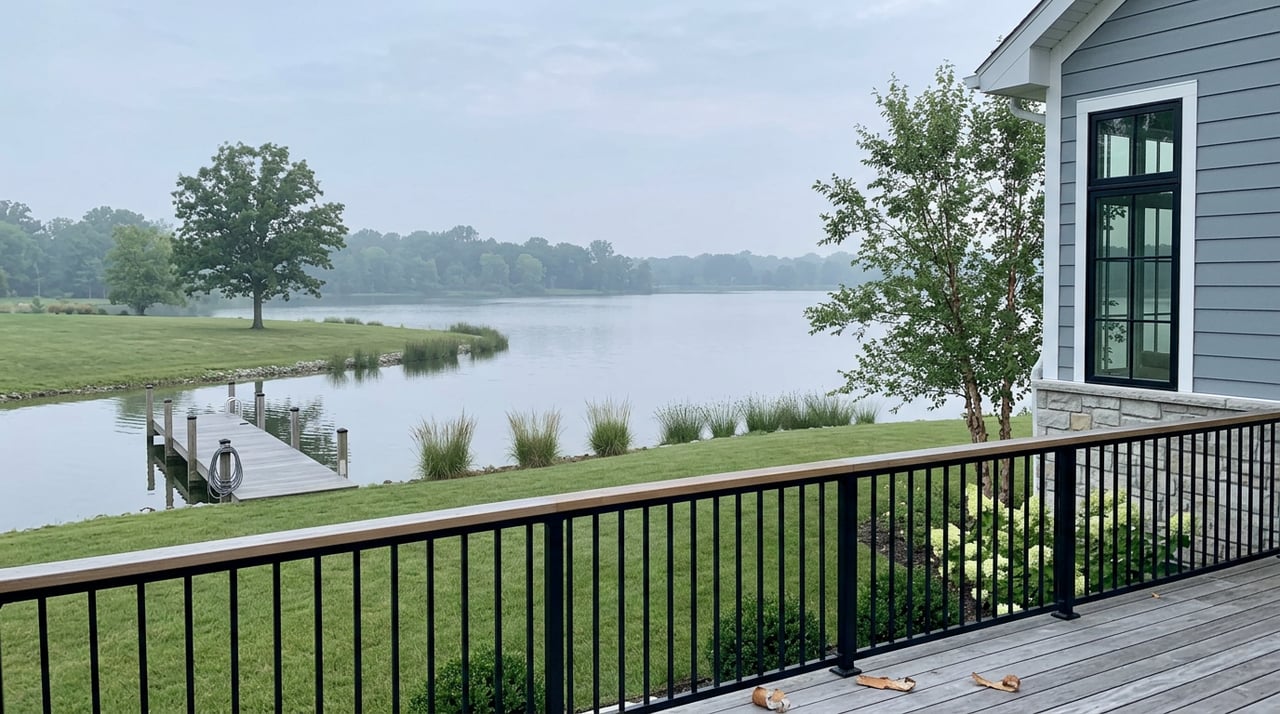
Two buyers tour homes on the same Saturday. One is on Flint Lake, three miles north of downtown Valparaiso. The other is on Lake Louise, inside the Shorewood Forest neighborhood on the city's west side. Both homes list in a similar range. Both have docks, mature trees, and water out the back window. On paper they look like the same product with a different address.
They are not. The differences do not show up in a median price. This is the piece of the Chain of Lakes market that a price-per-square-foot comparison will never surface, and it can affect the real monthly cost and the real use rights of a lakefront purchase.
The second bill: LAC Utilities
Homes clustered around Flint Lake often fall inside the Valparaiso Lakes Area Conservancy District, which operates under the name LAC Utilities. The district was formed in 1975 to take over a small water utility that was on the verge of going under, and it has since expanded into water supply, sewer collection, drainage, and flood control for the Flint Lake resort area, a neighborhood that has functioned as a getaway spot for Valparaiso residents for more than a century.
Here is the part a buyer needs to sit with: LAC Utilities does not generate its own water. It buys water wholesale from Valparaiso City Utilities and resells it to district customers, and it sends sewage to the city's treatment plant for processing. In other words, a home a few blocks outside the district gets billed directly by the city. A home inside the district gets billed by LAC Utilities under the district's own rate schedule.
That arrangement became a live local dispute starting in the fall of 2025, when a resident coalition calling itself "It's The Same Water" began petitioning the VLACD board to investigate whether the city could simply absorb district customers and change the billing arrangement for district customers. Lakeshore Public Media reported on the standoff in October 2025, noting that the group had pushed for months through petitions, canvassing, and board meeting appearances, and that the board had declined to pass a motion to research alternatives. VLACD posted its own response on its site, titled "The Truth Is Clear: Their Claims Don't Hold Water," disputing the coalition's framing. The district's board also issued findings in 2025 responding to a formal petition to appeal its 2026 tax levy. None of this is settled. If you buy inside the district right now, you are buying into an active rate argument, not a fixed cost.
The district's own numbers, from its most recently revised customer handbook in January 2025, show how the billing scales with meter size:
| Meter tier | Fire protection charge | Sewer base charge | Sewer volume rate |
|---|---|---|---|
| Smallest residential | $1.21/month | $26.51 | $0.0584/cu ft |
| Next tier up | $1.82/month | $26.51 | $0.0584/cu ft |
| Mid-size meter | $3.03/month | $66.28 | $0.0584/cu ft |
| Largest listed tier | $60.63/month | $1,325.50 | $0.0584/cu ft |
That is not a full picture of a monthly bill, and it will not tell you what the seller currently pays. What it does tell you is that the fee structure is tiered, published, and separate from anything the city charges outside the district's boundary. VLACD's bill-payment page says payment for water, sewer, and well accounts is due on the 20th of the month, sewer-only accounts are due on the 15th, and a missed payment triggers disconnection the following month on the 10th. A returned ACH payment carries a $30 fee These are the kinds of terms you find in a customer handbook, not a listing description, and they can matter to a lakefront buyer whose home is outside the city's normal utility footprint.
Not every lake plays by the same rules
The Chain of Lakes is not one lake. It is a system on the north side of Valparaiso that includes Flint, Long, Loomis, Wauhob, Mink, Moss, Round, Silver, Spectacle, and Deep, and they do not all operate under the same access or permitting rules.
Flint is the largest of the group, with a public boat launch on the south side and public beach access at Hillcrest and Burlington. Loomis is home to the city's Rogers Lakewood Park, with pavilions, boat ramps, and a dam on its north side that allows intermittent draining toward Lake Michigan. Long Lake's west shore is fully developed residentially, while its east side holds Geisemon Island, a nature preserve owned by the Woodland Savannah Conservancy, and a separate, larger island with a roughly 30-house development and the remnants of a hotel built in the 1920s. Vacation Pontoon Rental describes Flint Lake as a no-wake lake that favors paddle craft over motorboats.
That combination of public access points and public use is exactly the fact pattern Indiana law uses to define a "public freshwater lake" under the state's Lake Preservation Act. A lake used by the public with a riparian owner's acquiescence falls under the Indiana Department of Natural Resources' jurisdiction, and any construction below the shoreline or within 10 feet of it, including new seawalls, dredging, boat wells, or permanent piers, requires a DNR permit with a minimum $100 application fee. A temporary, easily removable pier can often skip that process under a general license, but a permanent dock or a shoreline alteration cannot.
The Lake Preservation Act explicitly does not apply to privately owned lakes.
Wauhob Lake adds a third pattern. It functions as a fishing hub with its own tackle shop, boat rental, and pier, and the homeowners around it have organized their own HOA that is active in lake preservation efforts independent of the city or the state. Round Lake, tucked behind it, is smaller still. Valpo Lakes describes the lake as private and reachable only by canoe or kayak through a channel from Wauhob. Three lakes in the same system, three different governance structures.
What this changes about your due diligence
Before you write an offer on anything touching this chain, the math you need is not the price per square foot. It is this sequence:
- Confirm which lake the property sits on and whether the parcel falls inside the VLACD service boundary, not just whether the listing description says "Flint Lake area."
- Ask the seller for the last twelve months of utility bills, whether that is LAC Utilities or standard Valparaiso City Utilities, so you can see the actual dollar difference rather than the posted rate schedule alone.
- If you are planning any shoreline work, a new dock, a seawall, a boat well, find out whether the lake is public-access like Flint, Long, or Loomis, which means budgeting time and a permit application with the Indiana DNR.
- Check whether the lake has its own homeowners association, as Wauhob does, since that group may have boating restrictions, dues, or maintenance obligations that never appear in county tax records.
- Build both the utility exposure and the permitting path into your offer and your inspection period, not just your appraisal.
Frequently asked questions
Does every home near Flint Lake pay LAC Utilities rates? Not necessarily. Coverage depends on the parcel's location relative to the district boundary. A property a short distance away may bill directly through Valparaiso City Utilities instead. Confirm this before you assume either way.
Can I put in a new dock without a permit? On a public-access lake like Flint, Long, or Loomis, a permanent dock or seawall generally requires a DNR permit under the Lake Preservation Act. A temporary, removable pier may qualify for an exemption.
Is the rate dispute going to lower my bill? There is no way to know yet. The coalition pushing for change and the VLACD board have not resolved the disagreement as of this writing, and the district's 2026 budget was already the subject of a formal tax levy appeal. Treat the current published rates as your baseline, not a ceiling.
Buying on the Chain of Lakes rewards the buyer who asks about the utility district and the permitting lane before falling for the view. If you are weighing a specific address on Flint, Long, Loomis, or one of the private lakes tucked behind them, Discover NW Indiana can walk the boundary lines, the bill history, and the permit path with you before you write an offer. Get your free home valuation and a straight answer on which set of rules your lake actually follows.
This article is general information, not legal, tax or financial advice. Consult a qualified professional about your situation.